Every week we meet owners and managers of small and mid-sized companies who know AI matters and are not sure where to begin. The tools change monthly, the advice is loud, and first experiments often stall after an encouraging demo. The way forward is calmer than it looks.
This guide covers where the value usually is, how to choose a first use case, when you do not need AI at all, how to think about building or buying, and a four-week plan to get something useful into the hands of your team.
Where the value usually is
- Customer replies: answering the same questions by email, chat or messaging, often outside office hours
- Documents and reports: reading invoices, contracts and forms, and writing the same kind of report again and again
- Sales follow-up: logging calls, writing follow-up messages and keeping the pipeline up to date
- Scheduling and coordination: bookings, reminders, rotas and the messages that go with them
Ask your team one question: what do you do every week that feels like copying? In most SMEs the answers fall into a few familiar groups.
How to pick the first use case
A simple score works better than a long debate. For each candidate, rate three things from one to five and multiply them.
Frequency: how often does the task happen? Daily beats monthly. Pain: how much time, frustration or risk does it carry today? Data available: does the information it needs already exist in documents, email or a system you can reach?
The multiplication matters. A task that is painful but rare, or frequent but with no usable data, scores low however exciting it sounds. Pick the top scorer that also has a clear owner: one person who cares about the result and will tell you honestly whether it works.
When you do not need AI
Not every repetitive task needs a language model. If the inputs are structured and the rules are clear, plain automation is usually faster, cheaper and more predictable. Filling the same fields into the same templates, moving data between two systems, or sending reminders on a fixed schedule are rules problems, not intelligence problems.
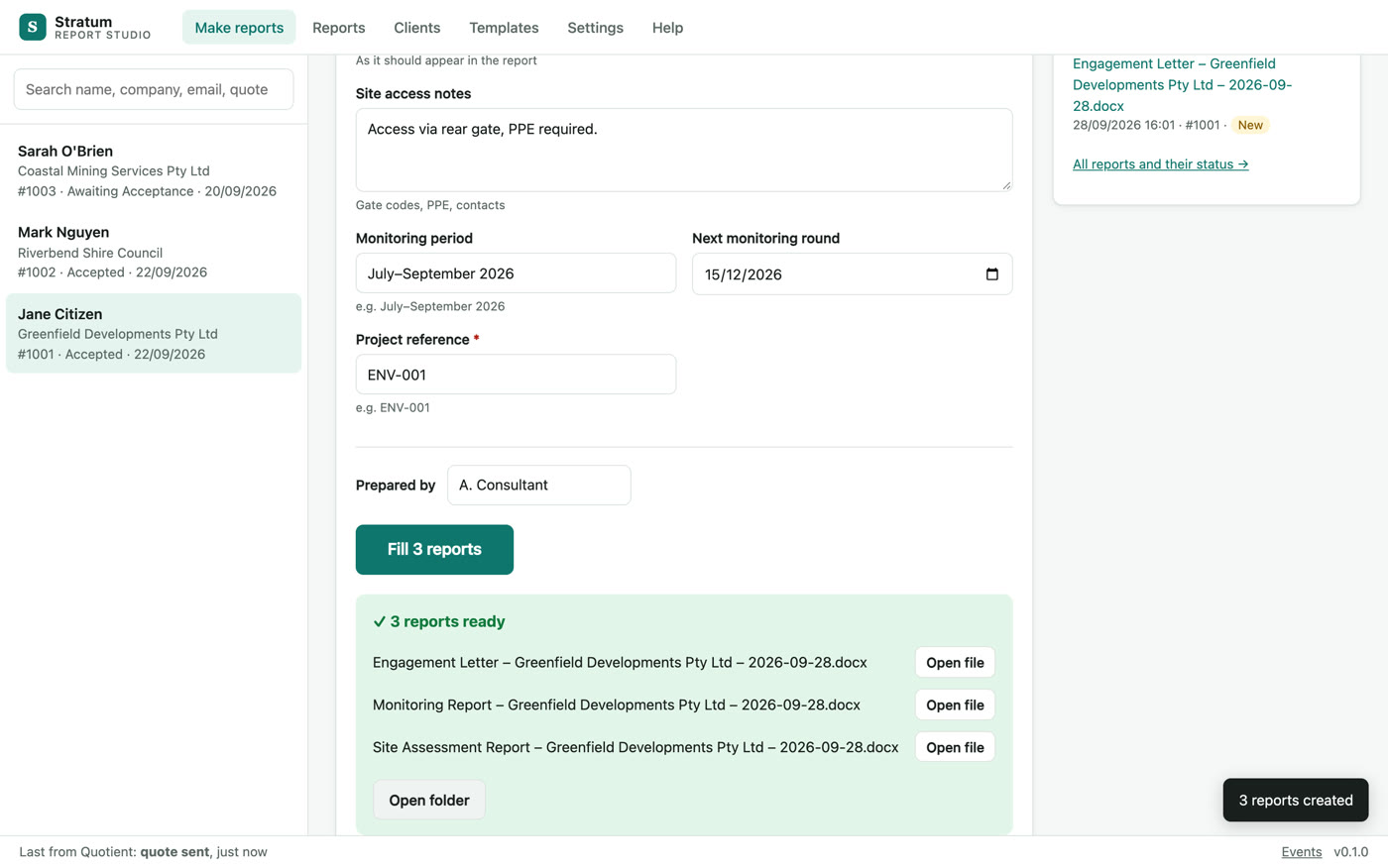
For an engineering consultancy, we built a desktop app that fills recurring reports from project data in one click. It uses no AI and runs entirely on the user's own computer. Every output is the same every time, which is exactly what the team needed. AI is the right tool when the input is messy, such as free-text emails or scanned documents, or when the output needs judgement or natural language.
The best first AI project is often a dull one: frequent, painful and built on data you already have.
Build, buy or configure
There are three realistic routes. Buying an off-the-shelf tool is fastest when your need is common, such as transcribing meetings or drafting general text. Configuring a platform you already use often covers simple assistants and automations. Building something tailored makes sense when the value depends on your own data, your own processes or a connection between systems that no product offers.
Many good solutions mix the three: a bought component for the generic part, and a small custom layer that connects it to your price lists, your customer records and the way your team actually works. Whatever the route, check where the data goes, who can see it, and how easily you could leave.
Costs, data and privacy
Costs come in three kinds. Subscriptions are usually charged per user or per volume and grow as adoption grows. A tailored build is a one-off project plus modest running costs for hosting and models. The cost people forget is internal time: cleaning up the documents the system will read, agreeing rules, and training staff. Budget for that from the start.
On data, a few basics keep you on the right side of GDPR and the EU AI Act. Know which personal data the system will touch and why. Prefer providers that process data in the EU and sign a proper data processing agreement. Tell customers when they are talking to an AI. Keep a person in the loop for anything that affects a decision about someone. For client or health data, consider running the AI on your own server, so nothing leaves the company.
Measuring results
Agree one number before you start, and measure it before and after. Good choices are hours spent per week on the task, time to first reply, errors caught before they reach a customer, or leads followed up within a day. Add one quality check, such as a weekly sample of outputs reviewed by the owner.
If the number moves, keep going and pick the next use case. If it does not, find out why: often the cause is data quality or a step people work around. Either way you have learned something useful at a small cost.
A four-week starter plan
- Week 1: chooseInterview the people who do the work, list candidate tasks, score them on frequency, pain and data, and agree the first use case, its owner and its success number.
- Week 2: prepareGather the documents and access the system needs, settle the data and privacy rules, and record the baseline measurement.
- Week 3: build and testBuild a first working version on real data and test it with the owner and two or three users. Fix what they find.
- Week 4: use and decidePut it into daily use for the small group, measure the agreed number, and decide whether to widen it, improve it or stop.
Questions we are often asked
Do we need an in-house technical team?
No. You need a clear problem, access to the people who have it, and a partner who stays until it works. Someone internal should own the result, but they do not need to be technical.
Is our data good enough?
Usually it is good enough to start. The first use case will show where the gaps are, and fixing those gaps tends to help the business beyond the AI project.
Will AI replace people on our team?
In the SMEs we work with, it mostly removes the repetitive parts of a job, so people spend more time with customers and on work that needs judgement.
Does the EU AI Act apply to us?
It applies to companies that use AI as well as those that build it, but most SME uses, such as answering customer questions or drafting documents, sit in the lower risk categories. The main duties are being transparent with people and keeping a human in charge of decisions.